I love the idea of art journaling. It’s described as “…a visual diary where you practice making art while expressing yourself at the same time…”
Because I’m trying to improve my art techniques to be able to illustrate children’s stories I wrote a few years ago, I decided a while back that keeping an art journal would be a good way to practice creating art.
In my previous post Art journal page 15: Benefits of art journaling, I explain how I cut out small pieces of watercolor paper to tape into my art journal, because the idea of messing up a page in the journal can block me from picking up a pencil or brush for hours. I tell myself that if I mess up my little work-in-progress, I can always throw it away and start over. And I think because I give myself that out, I’ve never needed to.
It’s been 3 months since that post and since I’ve picked up a paintbrush. Life events, as well as finishing and publishing my second book left me little time to work on my art journal.
I finally had time today. And even though I was worried that my skills were rusty and I had no idea what to draw or paint, I made myself sit down and do it anyway.
I went into my phone and found a photo that I took earlier this week near Fredericksburg of a house on a Civil War site called Slaughter Pen Farm. I picked the photo because I don’t like to draw buildings—you have to be so precise—and I felt that I needed the practice.
Below are the photo and the 2.5 X 5 inch watercolor I made from it:
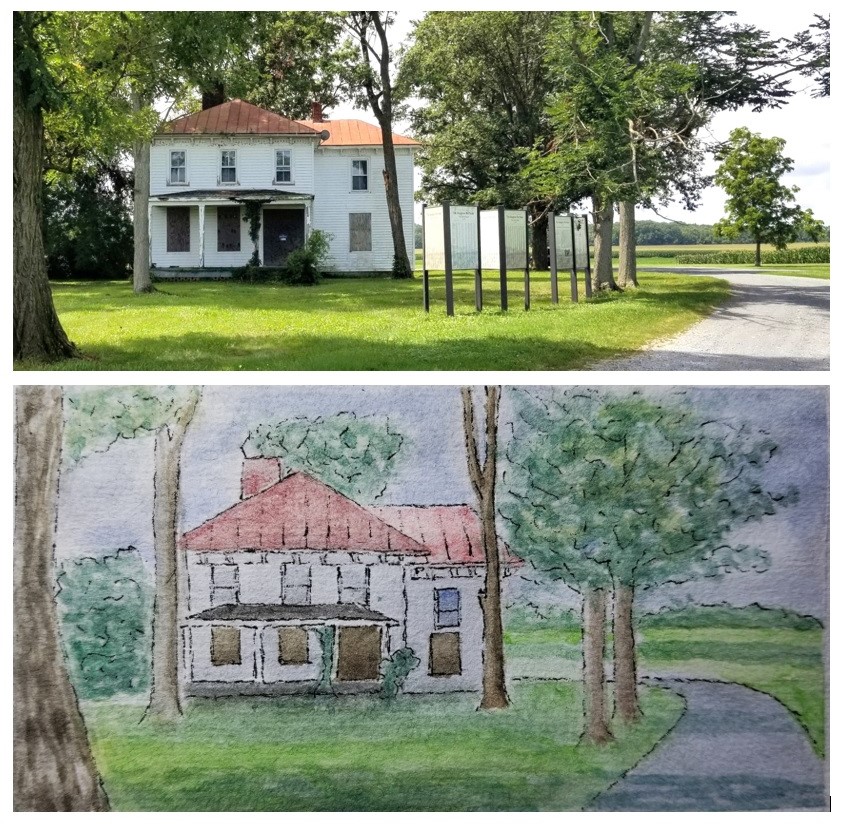
I deliberately left some things out of the watercolor, like the historical plaques in front of the house. It’s not great, but overall I think it’s not too bad, considering.
However, it could be better. More practice will helpfully improve my ability to translate what I see into what I draw. Nearly as important, I broke one of the basic rules of art—use good art supplies. I was worried that I’d mess up a piece of watercolor paper, so I used paper from a multi-purpose art pad I bought at a Dollar General last summer. The paper absorbed the water and pigment differently than watercolor paper, which made it harder to control and predict what they would do when they hit the paper.
So, your take-aways from this post are: create for your art journal even if you don’t feel that you are going to create something good—you might surprise yourself—and use good (not necessarily top-of-the-line, but decent) art supplies.
 Chessie art and crafts