I recently realized that it’s been three months since I last posted–in other words, too long.
I’ve been in a weird in-between space since September (it’s a long story) with the bulk of my art supplies (and other essentials) in a POD container two states away from here. Hopefully, our situation will be sorted out by the end of next month.
For creating art, I’ve been making do with a sketchbook, a travel set of watercolors and a 3-pack of small water brushes. Back in November I did some sketchbooking, but in the months since haven’t created art at all.
The ongoing stress of our personal situation combined with the bigger situation has left me with an apathy about a lot of things, including art. I’ve been spending a lot of my time doom-scrolling.
I recently saw someone on Instagram talking about how the act of creating can, while you’re doing it, shut down the worry part of your brain.
I decided it was worth a shot. After recently stumbling upon a set of gouache paints that I’d bought months ago and tucked away, I decided that it was time to do some creating.
I’ve never used gouache. My current art media preference is watercolors, but I was intrigued by the gouaches. Like watercolors they’re water-based but have an advantage over watercolors in being opaque, so that light colors can be placed on top of darks. With watercolors, if you’ve made something too dark, it’s difficult to make it light again.
So yesterday I set myself the simple task of creating a simple landscape scene twice, using gouache and then watercolor. I wanted to be able to compare the experience of using them and the results side-by-side.
I painted the first one using the gouache paints, a set of 15 colors by Himi that I bought on Amazon. I found their stiff, thick creaminess challenging after getting used to watercolors. And my small waterbrushes tended to water the paint down and do a poor job of spreading it evenly. After drying, I saw that thicker layers were cracking and a little crumbly. And while I like the richness of the colors, I didn’t like their overly bright unnatural hues. Below is the gouache painting:
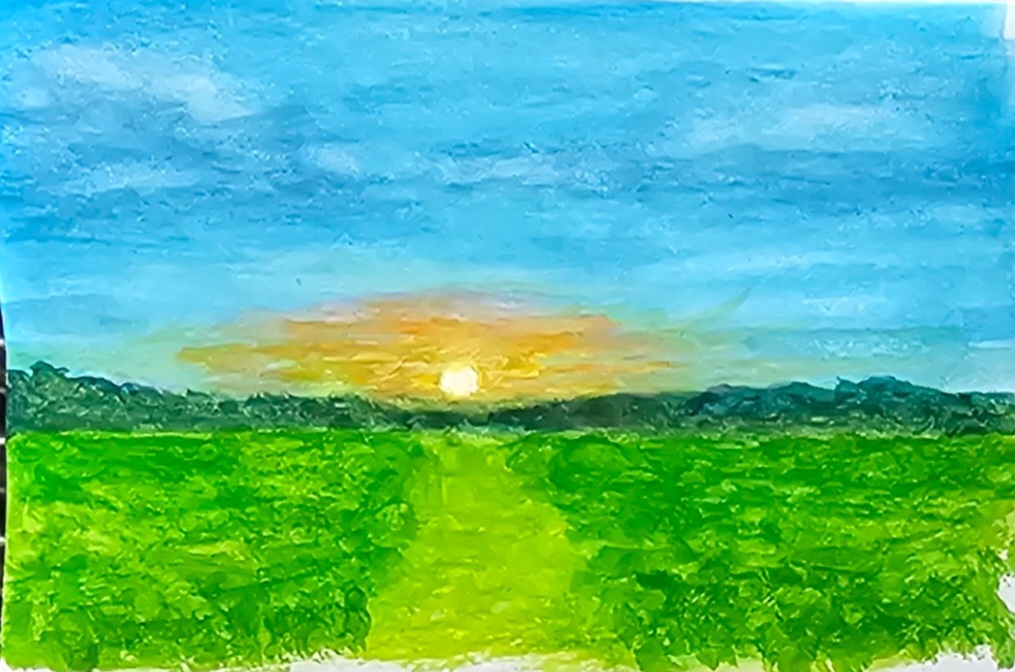
I then switched over to watercolors and painted another mini landscape (see below). As I struggled with it, I was reminded that paper that’s not made for watercolors can make using them a struggle–the paper warps and the watery paint tends to sit on top of the paper, not being absorbed like it should. The water brushes were another problem–their stiff nylon bristles were often lifting off more color than they were putting down. And then there was the bad decision making–I tried to blend a more natural looking green for the grass but ended up with a muddy, dull color.
I wanted to keep fiddling with the watercolor, but watercolors don’t lend themselves to fiddling.

It’s hard for me to say which results came out better. They look different in real life than in these photos, and I’d say the watercolor looks better overall. While the gouache is richer in color, its vivid colors look unnatural in real life. And I’m pretty sure that with proper paper and brushes (and a better choice for the shade of green in the grass) the watercolor would have come out better.
Of course, these are just quick little studies. Real paintings would take more time, supplies and effort than I was able to put toward these.
My takeaways? If I continue to use gouache, I need lots of practice to learn how to use it. As for the watercolors, besides practice, being rejoined with my full set of art supplies will help me to achieve better results.
Did the act of creating block out the worrying? I think so. While I was busy fretting over colors and blending and color lifting, I wasn’t fretting about…well, you know. Everything else.
 Chessie art and crafts